







 |
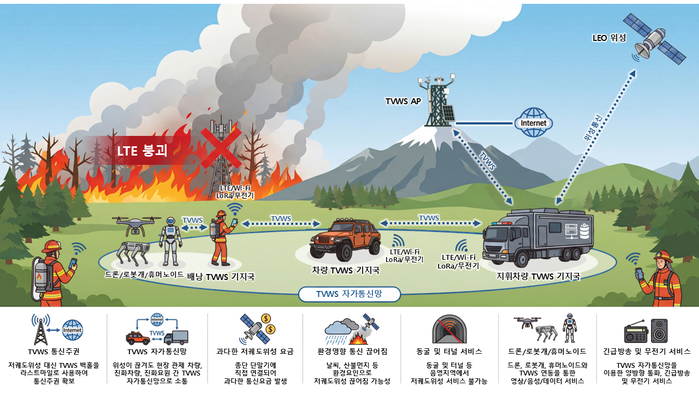
| ▲ 저궤도위성 백홀 TVWS 자가통신망 서비스 구성도 |
[매일안전신문=이정자 기자] 지난 5일 산림청은 ‘저궤도위성-LTE 융합기술 기반 산림디지털 통신 인프라 도입’ 사업 입찰 규격을 공고했다. 기후변화로 대형산불이 상시화되는 가운데, 재난 현장에서 끊기지 않는 통신망을 확보하기 위한 조치이다. 최근 수년간 반복된 대형산불은 통신망의 중요성을 다시 한 번 드러냈다.
◆ 대형산불, 실제로 통신이 흔들렸다
2022년 경북·강원 동해안 산불 당시 일부 산간 지역에서는 이동통신 기지국 정전과 광케이블 손상으로 통신 품질이 저하됐으며, 현장 지휘 체계에 부담이 가중됐다는 지적이 제기됐다.
2019년 강원 고성·속초 산불 때도 산악지형 특성상 일부 지역에서 통신 음영 문제가 발생했고, 소방 무전망과 이동통신망을 병행 운용해야 하는 상황이 벌어졌다.
재난안전 관계자는 “대형 산불은 전력·통신·도로가 동시에 피해를 입는 복합 재난”이라며 “현장에서 통신 두절은 곧 지휘 공백으로 이어질 수 있다”고 말했다.
◆ 정부도 ‘다중 통신체계’ 필요성 강조
행정안전부는 재난안전통신망(PS-LTE)을 국가 핵심 인프라로 규정하고 있으며, 재난 발생 시 통신의 연속성을 확보하는 것을 주요 정책 과제로 제시하고 있다.
행안부는 그간 재난안전통신망 고도화 및 이중화, 이동형 기지국 확충 등을 추진해 왔다. 산림청 역시 최근 발표한 산림디지털 전환 정책에서 “산불 대응의 디지털화 및 통신 인프라 고도화”를 강조했다.
이번 산림청에서 진행하는 저궤도위성-LTE 융합기술 입찰은 이러한 흐름의 일환으로 해석된다.
한국재난안전정책연구원 신병곤 원장은 “산불은 광범위한 산악 지형에서 발생하는 만큼, 저궤도위성 도입은 필수적이지만 다양한 통신 수단을 복합적으로 운용할 필요가 있다”고 밝혔다.
◆ 재난 통신망 붕괴는 곧 ‘국가 기능 상실’
재난 상황에서 통신이 두절되면 지휘체계가 무너지고, 이는 곧 국가 기능의 마비로 이어진다. 재난 상황에서 통신 통제권 상실은 국가 기능 마비로 이어질 수 있다.
많은 전문가들은 “재난안전 통신은 상업 서비스가 아니라 국가 인프라”라고 강조한다. 특히 외산 저궤도위성 서비스는 주파수 및 서비스 통제권이 해외 사업자에 있으며, 지속적 사용료 발생 및 비용 예측 곤란, 재난 시 서비스 제한 또는 중단 가능성, 통신 주권 확보의 불확실성 문제가 있다. 재난 상황에서 통신 통제권을 국내에서 확보할 수 있는지 여부도 중요한 정책 변수로 떠오른다.
◆ 저궤도위성의 장점과 구조적 한계
저궤도위성은 광케이블과 LTE가 붕괴된 상황에서 빠르게 연결을 복구할 수 있는 장점이 있다. 특히 산악지형이 많은 국내 환경에서 위성 백홀은 유용한 수단이다.
그러나 저궤도위성은 보완 수단으로는 활용 가능하지만, 통신 주권을 담보하는 핵심 수단으로는 한계가 존재하며, 현장에서 저궤도위성의 한계로 다수 전문가들은 저궤도위성을 ‘라스트마일’이 아닌 ‘무선 백홀’로 제한적 활용하는 구조가 바람직하다고 보고 있다.
▲ 업링크 속도의 제약
▲ 날씨·연기·산불 먼지에 따른 수신 불안정 가능성
▲ 동굴·터널·지하 공간 서비스 불가
▲ 과도한 통신요금 부담
◆ 해답은 ‘다계층 생존형 통신망’
재난안전통신망은 단일 조건이 아니다. 광케이블 붕괴, LTE 기지국 정전, 위성 단절 등 복합 상황이 동시에 발생할 수 있다. 국립전파연구원 성주영 박사가 제시하는 대안은 단일 기술이 아니라 다계층 생존형 통신망이며, 핵심은 “어떤 하나가 끊겨도 전체 통신이 유지되는 구조”이다.
▲ 1차망: 평상시 이동통신 + 광케이블 + TVWS 자가통신망
▲ 2차망: 광케이블 붕괴 시 LTE + TVWS 자가통신망
▲ 3차망: LTE 붕괴 시 저궤도위성 백홀 + TVWS 자가통신망
▲ 4차망: 저궤도위성 붕괴 시 TVWS 자가통신망 + 무전기
특히 라스트마일로 사용되는 TV 유휴대역(TVWS, 470~698MHz) 자가통신망은 장거리 비가시거리 통신이 가능하고, 산악·수목 밀집 지역 투과력이 높아 산불 환경에 적합하다는 평가가 있다. 태양광 기반 운용이 가능하여, 전력 인프라가 붕괴된 상황에서 생존성이 높다는 장점이 거론된다.
◆ 대형산불 현장은 ‘초연결 전장’
재난 현장은 점점 디지털화되고 있어서, 통신망이 단절되면 드론 영상, 위치 정보도 모두 멈추고 있다. 대형산불 현장은 긴급하게 대응해야 하지만, 관련 기관 및 사람이 다양하며 다양한 진화 장비가 투입되기 때문에 매우 복잡한 통신 환경이 형성된다.
특히, 단일화된 현장 재난 지휘체계를 수립하기 위해서는 위치 및 현장 시각화 서비스가 필수적으로 요구되며, 최근 활성화되고 있는 드론, 로봇개, 휴머노이드 연동 서비스가 고려되어야 한다.
▲ 현장 관제 차량과 진화 차량 간 음성, 영상 및 데이터 통신
▲ 진화대원 위치 추적
▲ 긴급 방송 및 양방향 무전
▲ 드론·로봇개·휴머노이드 연동
▲ 지하·터널·동굴 내부 통신
◆ 통신주권과 재난 대응, 균형 있는 접근 필요
전문가들은 재난 통신 정책이 단순 기술 도입이 아니라 통신 통제권, 비용 구조, 확장성 등을 종합적으로 고려해야 한다고 강조한다. 특히 통신 인프라는 한 번 구축되면 장기간 유지되는 특성이 있는 만큼, 국내 통제 가능성, 외산 의존 최소화, 예산 예측 가능성, 지자체 단위 확산성, 다계층 생존 구조 확보 등을 함께 고려해야 한다는 지적이다.
저궤도위성은 분명 중요한 수단이다. 다만 대형산불과 같은 복합 재난 환경에서는 위성을 포함하되, 그 외 통신 수단과의 역할 분담과 이중화 설계가 핵심 과제로 떠오르고 있다.
중앙소방학교 권오덕 팀장은 “기후위기로 재난의 강도가 높아지는 시대에 통신망은 선택이 아니라 생명선이다. 재난 대응 체계 강화를 위해 다양한 통신 수단의 역할 분담과 도입 방안에 대한 정책적 검토가 필요하다”고 강조했다.
다음은 위 기사의 영문판이다.
In an era of massive wildfires, communications networks are a lifeline.
- Low-orbit satellites are a complementary tool…A multi-layered, survivable communications network is needed.
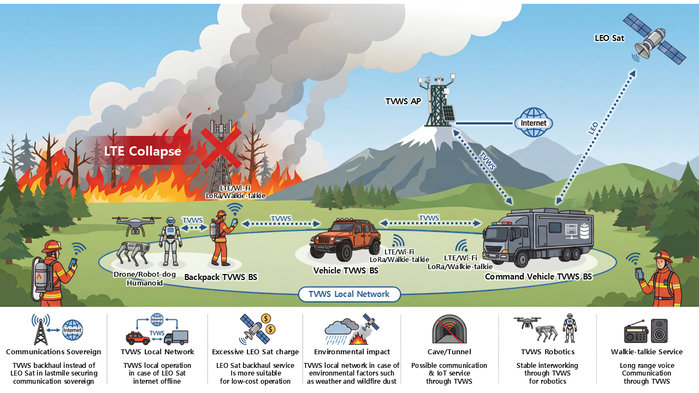 |
| ▲ LEO Satellite Backhaul TVWS Local Network Service Configuration |
[Maeil Safety Newspaper = Reporter Kang Su-jin] On February 5, 2026, the Korea Forest Service announced the bidding specifications for the "Introduction of Forest Digital Communication Infrastructure Based on Low-Earth Orbit Satellite-LTE Convergence Technology." This aims to ensure uninterrupted communication networks at disaster sites, amid the increasing frequency of large-scale forest fires due to climate change. The recurring pattern of large-scale forest fires in recent years has once again highlighted the importance of communication networks.
◆ Massive Wildfires Really Impact Communications
During the 2022 wildfires along the east coast of North Gyeongsang Province and Gangwon Province, communication quality deteriorated in some mountainous areas due to power outages at mobile base stations and damage to optical cables, placing a strain on on-site command systems.
During the 2019 wildfires in Goseong and Sokcho, Gangwon Province, mountainous terrain caused communication blackouts in some areas, necessitating the simultaneous operation of firefighting radio networks and mobile communication networks.
A disaster safety official stated, "Large-scale wildfires are complex disasters that simultaneously impact power, communications, and roads. Communication disruptions at the scene can quickly lead to a command vacuum."
◆ Government also emphasizes the need for a "multi-communication system“
The Ministry of the Interior and Safety (MOIS) has designated the Public Safety Long-Term Evolution (PS-LTE) network as a core national infrastructure and has set ensuring communication continuity in the event of a disaster as a key policy priority.
The MOIS has been promoting the advancement and redundancy of the public safety communication network and the expansion of mobile base stations. The Korea Forest Service (KFS) also emphasized "digitization of forest fire response and advancement of communication infrastructure" in its recently announced forest digital transformation policy.
The KFS's recent bid for low-orbit satellite-LTE convergence technology is seen as part of this trend.
Byung-gon Shin, President of the Korea Disaster Safety Policy Institute, stated, "Since forest fires occur in extensive mountainous terrain, the introduction of low-orbit satellites is essential, but it is also necessary to operate various communication methods in a comprehensive manner."
◆ Disaster Communication Network Collapse Means Loss of National Functions
In a disaster, a disruption in communications can lead to a breakdown in command structures, which in turn can paralyze national functions. Loss of communication control in a disaster situation can lead to a loss of national control.
Many experts emphasize that "disaster safety communications are not commercial services, but national infrastructure." In particular, foreign low-orbit satellite services have frequency and service control rights held by foreign operators. This presents challenges such as ongoing usage fees, difficulty in predicting costs, the possibility of service restrictions or interruptions during a disaster, and uncertainty over securing communications sovereignty. The ability to secure domestic control of communications in a disaster situation also emerges as a critical policy variable.
◆ Advantages and Structural Limitations of Low-Orbit Satellites
Low-orbit satellites offer the advantage of quickly restoring connectivity in cases where optical cables and LTE are disrupted. Satellite backhaul is particularly useful in Korea's mountainous terrain.
However, while low-orbit satellites can serve as a complementary measure, they have limitations as a core means of securing communications sovereignty. Given their limitations, many experts in the field believe that a structure that limits their use to "wireless local network backhaul" rather than "last-mile" services is preferable.
▲ Uplink speed limitations
▲ Possible reception instability due to weather, smoke, and wildfire dust
▲ Unavailability of service in caves, tunnels, and underground spaces
▲ Excessive communication charges
◆ The solution: a "multi-layered, survivable communications network“
A disaster safety communication network is not a single condition. Multiple situations, such as fiber optic cable failures, LTE base station outages, and satellite outages, can occur simultaneously. The solution proposed by Dr. Joo-young Sung of the National Radio Research Agency is not a single technology, but a multi-layered, survivable communication network. The key is a structure that "maintains overall communication even if any one component is interrupted."
▲ Primary Network: Mobile communications + optical cable + TVWS local network during normal times
▲ Secondary Network: LTE + TVWS local network in the event of optical cable failure
▲ Tertiary Network: Low-Earth Orbit Satellite Backhaul + TVWS local network in the event of LTE failure
▲ Fourth Network: TVWS local network + radio in the event of low-Earth Orbit Satellite failure
In particular, the TVWS (470-698MHz) local network, used as a last-mile service, is considered suitable for wildfire environments due to its ability to provide long-distance, non-line-of-sight communications and its high penetration into mountainous and densely forested areas. Its solar-powered operation is also considered advantageous, offering increased survivability in situations where power infrastructure is disrupted.
◆ Large-Scale Wildfire Sites: A "Hyper-Connected Battlefield"
A fire department official stated, "Disaster sites are becoming increasingly digitalized. If the communication network is disrupted, both drone footage and location information will cease." Large-scale wildfires require urgent response, but the diverse organizations, personnel, and firefighting equipment involved create a highly complex communications environment.
In particular, establishing a unified on-site disaster command system requires location and on-site visualization services, and the recently emerging drone, robot dog, and humanoid integration services should be considered.
▲ Voice, video, and data communications between on-site control vehicles and firefighting vehicles
▲ Firefighter location tracking
▲ Emergency broadcasts and two-way radio
▲ Drone, robot dog, and humanoid integration
▲ Underground, tunnel, and cave communications
◆ Communications Sovereignty and Disaster Response: A Balanced Approach
Experts emphasize that disaster communications policy should not simply adopt technology, but comprehensively consider communication control, cost structure, and scalability. Furthermore, given the long-term nature of communications infrastructure, once established, it is crucial to consider domestic controllability, minimizing dependence on foreign products, budget predictability, local government-level scalability, and securing a multi-layered survival structure.
Low-Earth orbit satellites are undoubtedly a crucial tool. However, in complex disaster environments such as large-scale wildfires, role division and redundancy design with other communication methods, including satellites, are emerging as key challenges.
O-duk Kwon, team leader at the National Fire Academy, stated, "In an era where the severity of disasters is increasing due to the climate crisis, communications networks are not an option, but a lifeline. To strengthen our disaster response system, we need to review policies regarding the role allocation and adoption of various communication methods."
[저작권자ⓒ 매일안전신문. 무단전재-재배포 금지]













![[포토뉴스] 임상섭 산림청장, 2025년 제1회 나무의사의 날 기념행사 참석](https://idsncdn.iwinv.biz/news/data/20250624/p1065597854320216_709_h2.jpg)
![[포토뉴스] 임상섭 산림청장, 제2회 대한민국 목조건축박람회 참석](https://idsncdn.iwinv.biz/news/data/20250312/p1065599501829032_959_h2.jpg)
![[포토뉴스] 임상섭 산림청장 “조경수산업협장과 교류·협력 강화해 나갈 것”](https://idsncdn.iwinv.biz/news/data/20241105/p1065602521893015_755_h2.jpg)